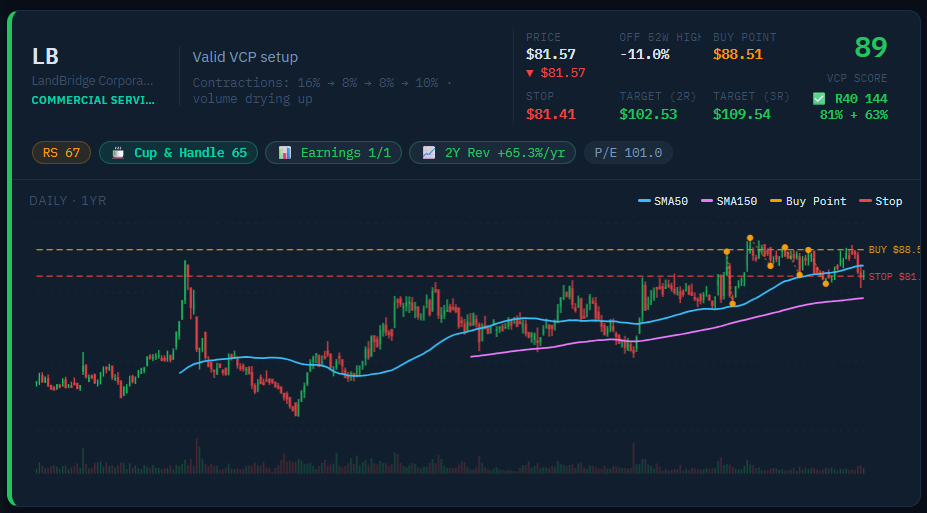
The last two weeks were difficult. Three positions hit their pre-set stops: MU, SNDK and LB. Each one closed for roughly a 7% loss, which is exactly the risk we set before entering. No stop was moved, no stop was skipped, and no loss was larger than planned.
The trades
- SNDK: bought at $1,709.00 on Sep 29, stop at $1,589.37. Stopped out at $1,589.37 on Oct 8. Loss: −$1,196.30 (−7.0%)
- MU: bought at $1,079.00 on Sep 25, stop at $1,003.47. The stock gapped down and opened at $1,000.52 on Oct 12, so we sold at the open for $1,003.00. Loss: −$760.00 (−7.0%)
- LB: bought at $85.50 on Oct 7, stop at $79.52. Sold at $79.50 on Oct 15. Loss: −$600.00 (−7.0%)
Total: −$2,556.30, or −$2,568.30 after commissions.
What happened after we sold
- SNDK has kept falling to $1,299.30, another 18% below our stop. If we had held, this trade would be down about $4,097 instead of $1,196.
- MU has dropped to $878.84, about 12% below our exit. Holding would have cost about $2,002 instead of $760.
The stops on these two trades saved about $4,100 compared with holding and hoping.
LB behaved very differently. On the morning of Oct 15 the market dropped hard; the Nasdaq-100 was down almost 2% at its low. That drop took LB to $78.28 and triggered our stop. By the close the market had recovered to flat, and LB finished at $81.25, back above our stop. Then today, Oct 16, the selling came back: the Nasdaq-100 fell 2.5%, and Micron and SanDisk fell 5.6% and 6.9%. LB closed green. A stock that holds up while everything around it is falling is showing relative strength. That's exactly what we look for, and our VCP screener still rates LB's base as valid (score 89).
Why we bought LB back
Today we re-entered LB: 100 shares at $80.66, with a new stop at $75.01 (7% below entry).
Some readers may ask whether buying back a stock we just sold breaks our own rule. It doesn't. The stop closed the previous trade, and that trade is finished. The loss is booked and counted above. Buying it back is a new decision, based on new evidence: the stock showed strength on a weak day and the setup is still valid. It gets its own entry, its own stop and its own defined risk.
What we will never do is hold a broken trade and hope. Selling at the stop and later re-entering on strength are both disciplined decisions. Refusing to sell is not.
Why we don't negotiate with the stop
A stop-loss doesn't predict whether a stock will recover. It tells us the setup we bought has failed, at least for now. A 7% loss needs about a 7.5% gain to recover. An 18% loss, like the one SNDK would have caused, needs about 22%. A 40% loss needs 67%. Small losses can be recovered from. Large ones end trading careers.
What we're taking from this
- The system did its job. Risk was set before entry and capital was protected. A losing streak is normal for any momentum strategy, and the losses stayed within plan.
- Gap risk is real. MU opened below our stop, so the exit filled slightly worse than planned. This is why position size matters as much as stop placement.
- Follow the strength. The selling has hit semiconductor and memory names hardest. We'll stay cautious there and focus on stocks like LB that are holding up while the market is weak.
The GetRicher Rule hasn't changed: let winners run, and never move a stop down.
We'll keep posting every trade, wins and losses alike.